Kinetic Display – Custom Motion Installation
The Kinetic Display was a custom motion installation built for a Dubai client, developed around a simple idea: technology designed to meet motion. Instead of a display that shows moving content, this is a display where the physical elements themselves move. The result gives a space a focal point with no single static viewing angle, which is exactly what captures attention in a place where people are moving through rather than sitting down.
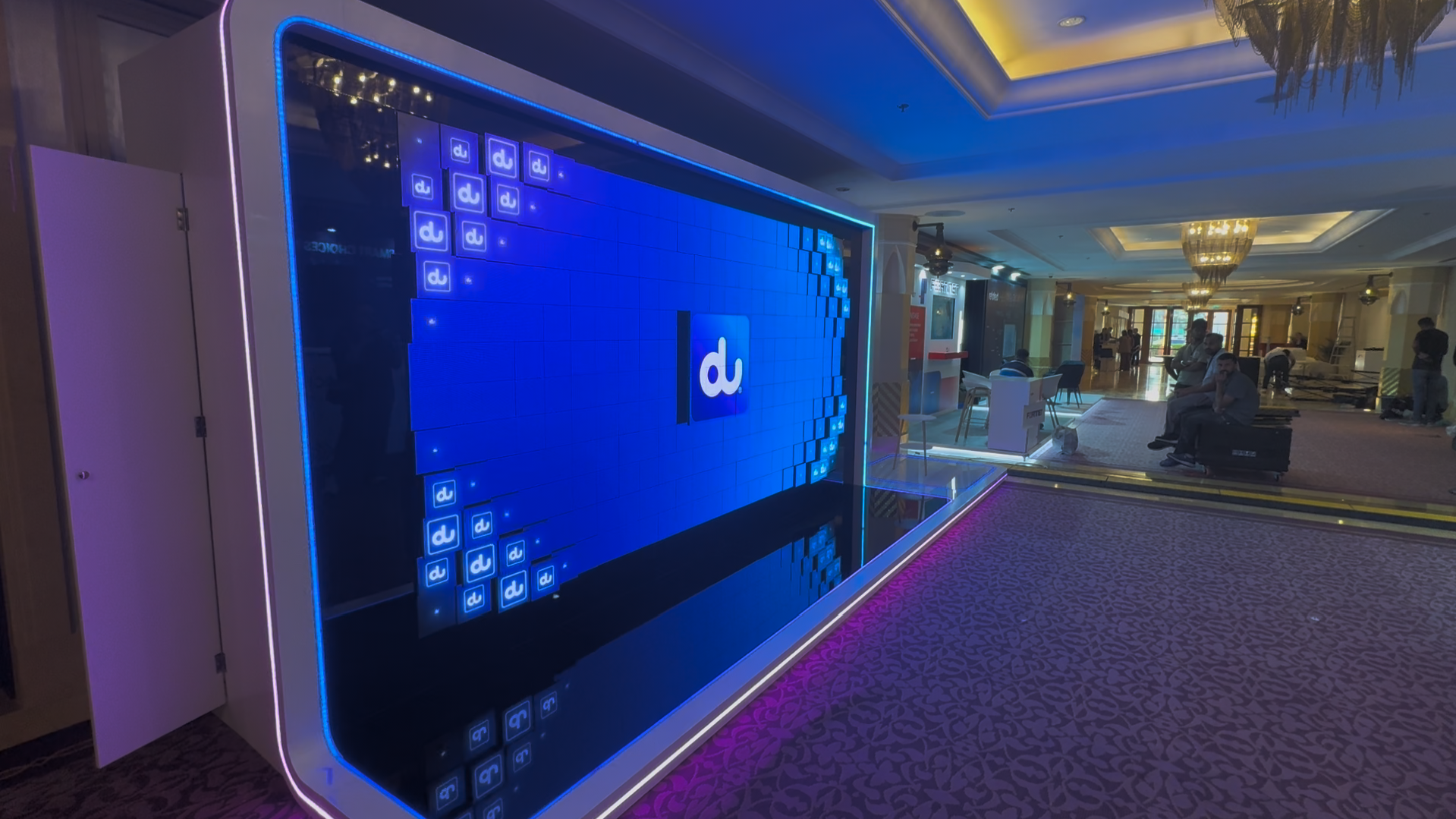
Kinetic DisplayA technology that's designed to meet motion for our client DU. Kinetic displays that captivate attention, spark curiosity, and leave a lasting impression.
Project Overview
- Client
- Confidential Client
- Location
- Dubai, UAE
- Year
- Ongoing delivery
- Event Type
- Brand Installation & Flagship Experience
- Industry
- Brand Experience & Retail
- Application
- A kinetic display built around a technology designed to meet motion, creating a moving visual installation that captures attention and gives a brand space a physical centre of gravity.
- Solution
- A custom kinetic display system in which multiple physical elements move in programmed response to create a dynamic focal point with no single static viewing angle.
- Technology
- Custom Mechanical Motion Systems, Programmable Motion Control, Custom Fabrication & Engineering, LED & Lighting Integration, Show Programming
The Challenge & Objective
A kinetic installation is one of the harder things to specify, because a static render never communicates what motion actually feels like. Getting a client and a venue to commit to one requires making the value legible up front.
- Make motion the point, not a decoration. Many installations add movement on top of a screen. Here the movement had to be the primary message, which changes every other design decision.
- Work from every angle. Guests walk around an installation like this, so it cannot have a front. That is a structural constraint, not an aesthetic preference.
- Create a focal point in a real space. The installation had to hold a room rather than sit on a stand, which meant thinking about scale relative to the venue rather than relative to a screen.
- Move safely and repeatedly. Continuous programmed movement over a full event day requires mechanical reliability and guarding, not just a good first cycle.
- Remain maintainable. Complex motion hardware needs an operating model the client's team can actually run.
Our Solution
We started from the behaviour we wanted people to see, and designed the mechanics, the structure and the control around it.
Programmed motion as the core experience
Rather than a screen playing animation, the physical elements of the display were driven through programmed movement patterns. That gives the piece a quality no screen can reproduce: real mass, real momentum and real sound. It also makes the installation genuinely ownable by the brand, because the movement pattern itself becomes part of the identity.
Custom fabrication and structural engineering
The mechanics and structure were developed for this installation specifically, sized against the venue so the piece held the room rather than reading as a product placed inside it. Fabrication and engineering were handled in-house, which is what allowed the movement to be designed around the visual goal instead of adapted from a standard mechanism.
Lighting and visual integration
Lighting was integrated into the movement so the piece reads as one object in motion rather than as a mechanism with lamps on it. The relationship between light and movement is what makes a kinetic display feel designed — and it is a large part of how we approach [kinetic LED](/event-technology/kinetic-led/) work generally.
An operating model the client can run
Programmed sequences, documented operating procedures and our on-site support meant the client team could run the installation through a full event day without a technician permanently stationed beside it. For complex motion hardware, that handover is the difference between an installation that runs and one that gets switched off.
Technology & Implementation
A custom mechanical and control build, engineered for continuous programmed operation in a public space.
Motion system design and mechanical engineering
The movement pattern was designed first and the mechanics engineered to deliver it, including load, speed, repeatability and guarding for a public environment. Continuous-motion hardware has to be specified for thousands of cycles rather than one good demonstration, which is where most kinetic installations fall short.
Programmable motion control and sequencing
Movement was driven by a programmable control system running pre-authored sequences, so the piece behaved the same way every time and could be triggered from a single control point. Pre-programmed motion is more reliable and far easier to hand over than live control.
Custom fabrication and finish
Structural and cosmetic fabrication were completed in-house and finished to suit the venue. For a piece this size, the finish quality is what separates a designed installation from an engineering prototype, and it is the part guests judge most closely.
Installation, testing and operation in Dubai
The installation was delivered and tested on site in Dubai, run through full operating cycles before opening, and supported by our technicians during the live period. Any kinetic build we deliver is commissioned properly on site rather than assumed to work after delivery.
Results & Impact
The installation did what only real movement can do: it gave a space something to stop and watch.
- Guests stopped for the motion itself, which is a stronger form of attention than watching a screen.
- The installation worked from multiple angles, so it functioned as a room centrepiece rather than a viewpoint-specific feature.
- Custom engineering meant the movement could be designed around the intended effect rather than adapted from an available mechanism.
- Documented operation meant the client team ran it confidently for the full programme.
Services Used on This Project
Event Technology by Location
Related Projects
Frequently Asked Questions
Common questions about this Confidential Client project and how Ultratec4D delivers similar event technology.
What is a kinetic display?
It is a display where the physical elements move — the screen, the light or the structure itself is in motion, rather than showing a moving image. In this Dubai installation the motion was programmed and was the primary experience, giving the piece real mass and momentum that a screen cannot reproduce, and giving a brand space a focal point with no single viewing angle.
How is a kinetic installation engineered for repeated use?
Continuous-motion hardware has to be specified for thousands of cycles rather than one good demonstration, so the engineering covers load, speed, repeatability and guarding for a public environment. We also build movement as pre-programmed sequences driven from a single control point, which is far more reliable to run and to hand over than live control.
Can kinetic displays be integrated into a brand space?
Yes. Because the mechanics are custom, the movement pattern can be developed as part of the brand identity and the piece scaled to the room it sits in. We handle fabrication, control programming, lighting integration, installation and operation, which is how we deliver [kinetic LED](/event-technology/kinetic-led/) and custom motion work across the UAE and Saudi Arabia.
Do you install kinetic displays in Dubai?
Yes. We design, fabricate, install, commission and operate kinetic and motion installations across Dubai, Abu Dhabi, Sharjah, Riyadh and Jeddah, including on-site testing and full handover documentation for the client team.
Looking for something guests will stop and watch?
Tell us the space and the feeling you want. We will propose a motion concept, the engineering it needs and the operating plan for your venue in the UAE or Saudi Arabia.
Serving Dubai, Abu Dhabi, Sharjah, Riyadh, Jeddah and the wider GCC